Why "Emerging" Economies Must Adopt the Language of Sovereignty in Stablecoins
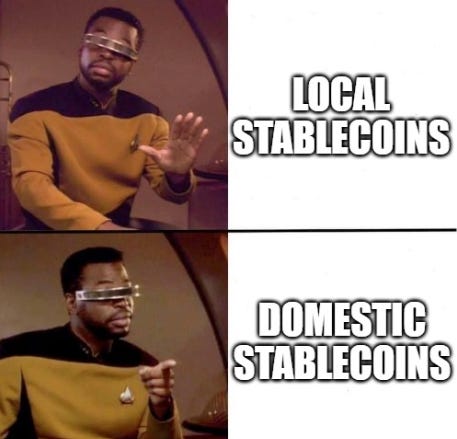
Local Shrinks The Future, Domestic Builds It.

If your digital rails clear in dollars, your economy becomes a client of the Federal Reserve’s cycle.
In money, vocabulary is policy by other means. The labels we choose hard-code how regulators evaluate risk, how bankers assign credit, and how citizens decide what to trust. That’s why the term “Local Stablecoin” is a strategic misstep for any country or people serious about monetary sovereignty, and why “Domestic Stablecoin” is the superior nomenclature if the ambition is to strengthen, not outsource, national monetary power. And for African countries, this is more important.
Semantics play a crucial role in steering policy
“Local” connotes the parochial: small-scale, peripheral to the core monetary system. It suggests geography rather than jurisdiction. Policymakers hear “local” and think pilot or fringe fintech. Markets hear “local” and price a discount in legitimacy. People hear “local” and frame it as a curiosity, not an instrument of state capacity.
“Domestic,” by contrast, is a term wired into the institutional lexicon: domestic liquidity, domestic money supply, domestic settlement systems, domestic market operations. It speaks the language of central banks, fiscal authorities, payment system operators, and prudential regulators. It signals that the instrument is inside the perimeter, subject to national law, aligned to national objectives, designed to serve and create exponential value to the domestic economy.
If the goal is to counter dollarization, deepen “local” capital markets, and digitize the national unit of account, “domestic” tells the right story to the right audiences.
Narrative isn’t fluff - it’s the coordination layer
Narrative is the first domino. A narrative frames the problem, legitimizes a solution, and organizes coalitions. Get the narrative wrong, and you won’t even reach the technical debate - the idea dies in the lobby, long before it meets a policymaker’s pen.
Regulators greenlight what they can defend. “Domestic stablecoin” is defensible within monetary policy mandates; “local stablecoin” sounds like an NGO pilot.
Banks integrate what improves their balance sheet and prudential optics. “Domestic” implies KYC/AML alignment and eligibility for integration into domestic rails.
Citizens adopt what carries social proof. “Domestic” reads as national infrastructure, not a hobbyist token.
History’s quiet censorship by label
History has always disguised hierarchy in language. The global economy’s architecture was not built only through trade and policy, but through labels that quietly scripted who leads and who follows. Consider how naming itself has shaped the trajectory of monetary and economic thought:
“Third World,” “frontier,” “periphery.” These labels didn’t just describe, they assigned status. They moralized risk and hardened a global pecking order that still shapes spreads, access, and perception.
The “Washington Consensus.” A phrase that canonized one policy bundle as neutral science. The label made dissent look irrational and justified structural adjustments whose costs were borne domestically while benefits were externalized.
“Original sin.” The tidy story that emerging markets “must” borrow in foreign currency. It became a self-fulfilling constraint, locking countries into exposure where foreign monetary policy leaked directly into domestic balance sheets.
The CFA franc’s “stability” narrative. Stability was real, but so was the opportunity cost in monetary autonomy. The label foregrounded price stability and backgrounded sovereignty.
The “petrodollar.” A phrase that embedded a monetary standard in commodity trade psychology. Once the story stuck, switching costs rose and the narrative erected network effects.
Mobile money as “shadow banking.” Early dismissals kept it outside formal rails longer than necessary. Only when reframed as a national payments infrastructure did it receive the regulatory clarity that unlocked scale.
Each case shows how a label can either entrench subordination or scaffold autonomy. “Local stablecoin” risks repeating the old mistake: self-diminution by self-description.
The stakes in digital assets: who governs the denominator?
USD-backed stablecoins export U.S. monetary policy into every economy where they dominate. They are convenient, liquid, and globally interoperable, but they make your domestic prices, wages, and savings more sensitive to decisions taken in Washington than in Accra, Nairobi, or Lagos. That is not a conspiracy; it’s plumbing. If your digital rails clear in dollars, your economy becomes a client of the Federal Reserve’s cycle.
A Domestic Stablecoin - fully reserved in the national unit, subject to domestic prudential standards, integrated with domestic Real Time Gross Settlement(RTGS) and faster-payments rails, internalizes that power. It enables:
Sovereign transmission: Monetary policy actually transmits through digital channels that citizens use.
FX defense: Domestic digital liquidity that competes with USD tokens at the point of use.
Market deepening: Programmable settlement in the home currency for bills, taxes, payroll, B2B invoices, etc, expanding the demand for the national unit of account.
Supervision by design: On-chain reporting and circuit breakers tied to domestic law.
None of this lands if you brand it “local.” “Local” is the label you put on a community voucher. “Domestic” is the label you put on infrastructure.
Why “local” backfires - even when well-intentioned
Policy optics: “Local” invites segmentation. Regulators treat it as a ring-fenced experiment rather than a systemic tool, starving it of the integrations (tax payment acceptance, treasury operations, government disbursements) that create real utility.
Capital optics: Institutional investors and banks perceive “local” as higher governance risk and lower exit optionality. The discount shows up in adoption and pricing.
Public optics: Citizens already conflate “crypto” with speculation. “Local” doesn’t fix that. “Domestic,” paired with visible state-adjacent integrations, does.
A Constructive Reframe
The antidote to linguistic self-limitation is not to invent new jargon, but to reclaim existing authority. A domestic stablecoin should be called exactly what it is: a nation’s currency, rendered programmable — a modern extension of the state’s monetary fabric, not a parallel token economy. It is not an imitation of the dollar or a derivative of crypto; it is the digital continuation of sovereign money, upgraded for a networked age.
To describe it as such is to restore hierarchy in the architecture of finance. The central bank remains the conductor of monetary rhythm; commercial banks, fintechs, and blockchain protocols become instruments in the orchestra. Code replaces paperwork, wallets replace accounts, but the song remains national. The domestic stablecoin becomes the API of sovereignty. The programmable layer that allows citizens, firms, and the state to transact within the same legal perimeter at digital speed. Its design principles follow naturally from its name.
It should be fully reserved in the national unit, ensuring one-to-one convertibility and preventing synthetic leverage. It must operate under domestic prudential standards, embedding compliance, transparency, and risk controls in code rather than committees.
It should connect to national payment infrastructure - RTGS, instant payment networks, and fiscal rails, so that every digital transaction reinforces the existing monetary base instead of fragmenting it.
Narratively, it demands a recalibration of metaphors.
The domestic stablecoin is not “crypto” in the speculative sense; it is digital cash with institutional memory. It is not a threat to central banks but a reinforcement of their relevance in a dematerialized world. It is not an experiment in tokenization but an assertion that national money can evolve without losing its sovereignty. It reclaims the monetary frontier from foreign denominators and aligns digital innovation with fiscal identity.
Properly framed, the domestic stablecoin becomes a bridge between legacy systems and emerging networks. A digital bloodstream carrying national value through global veins. It is both policy and protocol, as well as infrastructure and symbol. It embodies the possibility that technological progress does not need to erode sovereignty but can, in fact, encode it.
It’s time to stop self-minimizing
Emerging economies have too often inherited names that make their systems sound informal, marginal, or perpetually “developing.” The digital asset frontier is a rare reset button. Do not squander it with a minimizing label.
Name it right, and you don’t just win a semantic debate. You tilt the coordination game toward sovereignty, so the next decade of digital money is built with your country, not merely despite it.